With all the talk of freshman studs possibly winning this year I thought I would take a look at the history of freshman at the NCAA tournament. But before we do that let’s look at this year’s crop of young guns.
Young Guns, Big Expectations
What exactly are the expectations for this year’s freshmen based on the latest rankings? There are fourteen freshman ranked among the top six at their respective weight. As mentioned, 133 leads the way with four, followed by three each at 149 and 157.
At the individual level their chances looks like this (filtered to top 6 ranks):

- The three #2 seeds (Sergio Vega, Marcus Blaze, Angelo Ferrari) lead the way with an almost 1 in 5 chance to take home the title.
- Right behind them the pair of #3’s (Davino, Sinclair) have a similar chance (17.3%).
- After that the odds drop off fast (less than 10%).
As a group the expectation is for 1.3 titlists:
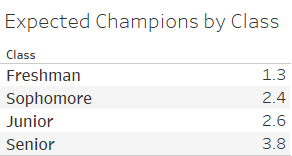
That 1.3 expected champs breaks down as follows:
- Chance of 0 = 21.3%
- Chance of 1 = 39.7%
- Chance of 2 = 27.8%
- Chance of 3 = 9.4%
- Chance of 4 = 1.7%
- Chance of 5 = 0.2%
- Chance of 6 = 0.007%
- Chance of 7 = 0.000175%
- Chance of 8 = .000001%
- Chance of 9 or 10 = 0%
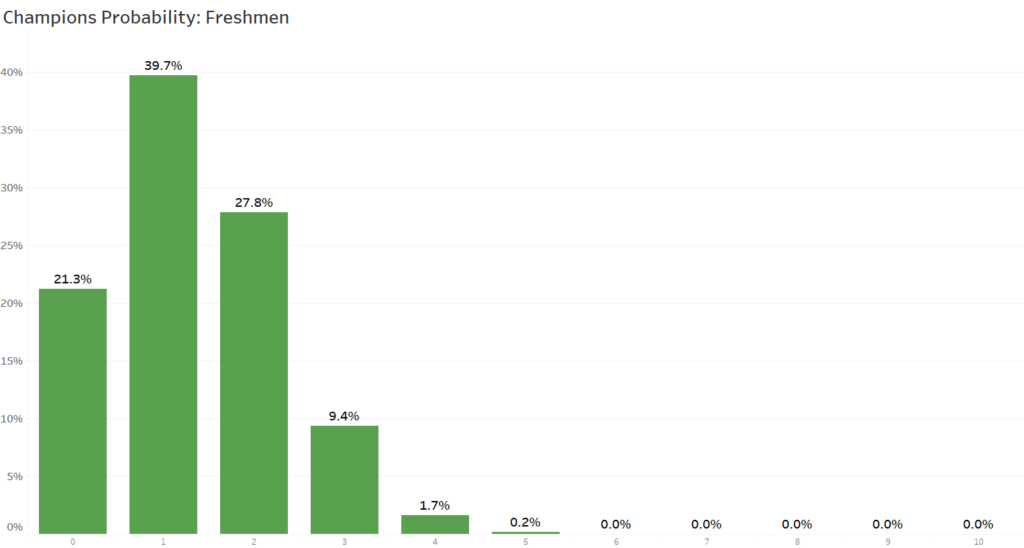
Based on that distribution zero to two is pretty likely with a shot at three. Where does it stand historically?
The Freshmen Eligible Era
Beginning with the 1969 season freshmen have been continuously eligible. While the tournament tends to be dominated by grizzled veterans the apple-cheeked kids have had their occasional moment in the sun.
- From 1969 – 2025 there have never been more than two freshman champions in a single tournament.
- All told have only been nine instances of two freshman champs.
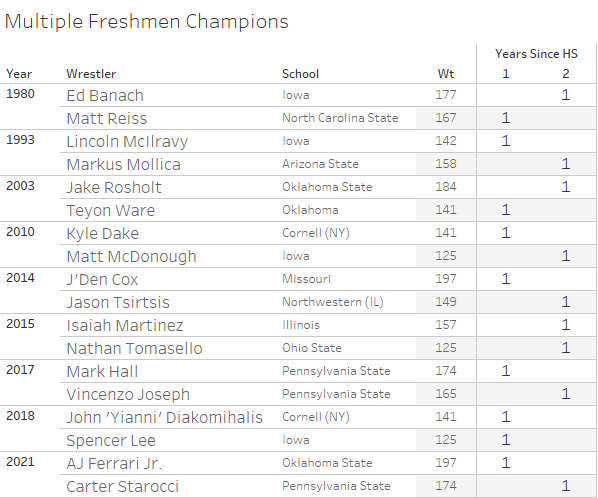
- In eight of nine instances one of the two was a red-shirt freshman.
- Only the 2018 pairing of Yianni Diakomihalis and Spencer Lee featured two true freshman standing alone at the top of the podium.
So the bar is set at two. Three freshmen champions from this class will set it apart from all the rest. And we already know there is about a 1 in 10 chance of that happening with this crop.
But Wait There’s More
It turns out I played a little fast and loose with the definition of “freshmen eligible era”, as that term should be pluralized.
After WW2 there was a short period of time where freshmen were eligible. I have had a hard time confirming the exact years but I believe it started in 1946 and either ended in 1949 or 1950.
Since the original logic for not allowing freshmen to be eligible centered on their need to adjust to the rigors of academic life, I imagine this temporary change was made to reflect the fact that men returning from war were not going to be cowed by combining school with sport.
For three years (1943, 1944, 1945) no tournament was held due to the war. For a number of reasons, the 1946 tournament was sparsely attended, including that it was only decided six weeks prior to even hold the tournament. From a pre-war high of 131 wrestlers in 1935, attendance was down to 54 that year.
By 1947 things were returning to normal with 100 total participants. That was also the year things got very abnormal. In 1947 there were a whopping five freshman champions. And lest you think this was a case of old men disguised as freshmen picking on young men, only two of the five were returning GI’s.
- 121: Dick Hauser – Cornell (Iowa), true freshman (~18-19 years old)
- 136: Lowell Lange – Cornell (Iowa), true freshman (~18-19 years old)
- 165: Bill Nelson – Northern Iowa, true freshman (at 20 years old it looks like he took a year either before or during high school and maybe another after high school).
- 175: Joe Scarpello – Iowa, US Air Force veteran who flew 18 missions over Germany (24 years old)
- UNL: Dick Hutton, Oklahoma State, US Army veteran (23 years old)
With only eight weights in 1947 62.5% were won by freshmen.
Can seven 2026 freshmen take the titles and the title from this vaunted 1947 crew? We already know the chances are 0.000175% or about 1 in 6 million.
And we also already know what Lloyd Christmas has to say about that.
5 responses to “Youth Will Be Served (or I can’t stop thinking about the 133 bracket this year where there are four freshmen ranked in the top six)”
No Seidel at 133?
Joe: I had a mistake in the description of the table. It is actually filtered to top 6 as below that seed the chances become very small and the list gets very long. I have fixed the description.
Seidel is ranked 7 at the moment and while he is not on that list, his chances are included in the 1.3 total.
Thank you for the head’s up and for reading.
Nice job but without Forrest and Seidel it has a lower threshold than is realistic. Except they are the same weight as two others so maybe the numbers aren’t impacted but the names may change. Each has as good a chance as Blaze or Davino within a couple percentages.
Sorry I see Forrest now, I would like the return on an investment, and you put money on him.
The Forrest number is likely to change a lot after the conference tournaments.
I imagine he will be a top 4 seed, unless he is too penalized in the seeding formula by his lack of matches. I really have no desire to figure that out, though.
Right now he is outside the top 4 rankings and the top 4 have won 100 of the last 110 titles (91%). And one of the ten from outside the top four was Starocci, so really 101 of 110.