Let’s acknowledge the obvious first. Every match matters. Teams that win titles win a lot of matches and each win is a part of the tapestry of a title. It is hard to single out any one match as being more consequential than any other.
So, guess what I am going to do now.
I bring you The Most Consequential Matches in NCAA History.
That is a bit grandiose. What these really are are matches between wrestlers from the first and second place team finishers (and one third) that had they gone the other way would have resulted in the second-place team placing first and the first-place team placing second. They could have flipped the script.
2018 Bo Nickal Penn State) PF Myles Martin (Ohio State) 184 Final
HE’S GOT THE CHIN, HE’S GOT THE CHIN.
Speaking of flipped. Let’s start with the most recent example.
It was 2018. The wife and I were attending our first NCAA tournament. We knew nothing. But when Bo Nickal was taken to his back by Myles Martin in the 184 final with Ohio State trailing Penn State by a mere 6 points (and Kyle Snyder favored in the 285 final), we knew enough to know that was a bad place to be. But then a wrinkle in the space/time continuum occurred and Nickal had Martin on his back instead. Penn State fans went from “OH NO”, to “OH YES” in the blink of an eye. Regular service was restored, Penn State won the title, and an iconic wrestling image was created….To the great annoyance of all non-Penn State wrestling fans.
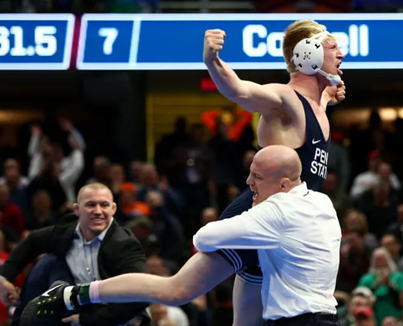
In the end, Kyle Snyder’s heavyweight final became inconsequential to the title race, even as it held great meaning for him personally.
2009 Brent Metcalf (Iowa) dec. Lance Palmer (Ohio State) 149 Semi-Final
Three times a charm
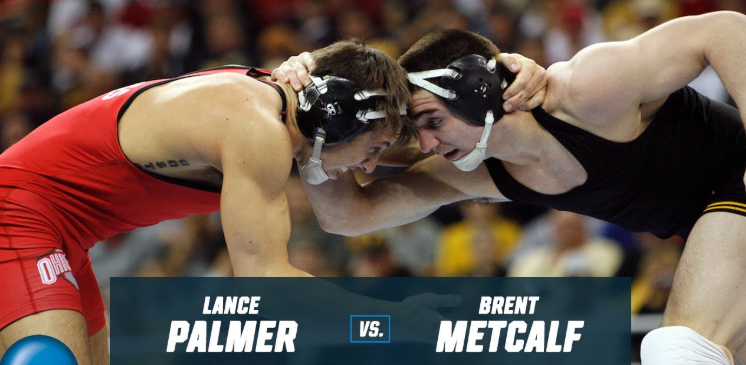
Metcalf and Palmer would meet in the NCAA tournament three years in a row. And three years in a row Metcalf would come out on top. In 2008 they met in the quarterfinals and Metcalf eked out a 3-2 win. In 2010 Metcalf would beat Palmer in the final by the same 3-2 score. But it was the 2009 semi-final that held the most significance for the team title.
Metcalf took this one 6-2 on his way to a second-place finish. Palmer would also lose his last bout and finish fourth. Reverse that one semi-final outcome and Palmer is in the final while Metcalf goes to the backside. If Palmer loses the final and Metcalf wins out, without scoring bonus, to take third, it is a 5.5-point swing in favor of Ohio State. Iowa beat Ohio State by 4.5 points for the title.
1978 Bruce Kinseth (Iowa) dec. Joe Zuspann (Iowa State) 150 Semi-final
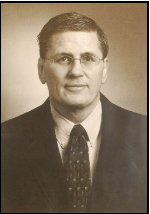
That may be the face of hospitality today, but don’t tell Iowa State that
This is another example of Iowa showing its clutch gene. But this time the margins were even finer, and they still needed a little help from an unlikely ally, or allies.
Zuspann entered the tournament as the #2 seed having just won the Big 12 title with an upset victory over Oklahoma’s Dave Schultz. Kinseth was the #3 seed, making his semi-final win a minor upset and paving the way for Iowa to win the closest team race in NCAA history.
Iowa 94.5 – Iowa State 94.
But there was a second chapter to this one. Kinseth would get pinfelled in the final while Zuspann would advance to the third-place match where he would meet an old, familiar, recently vanquished foe, Dave Schultz. A win, any kind of win, would do. Well, they wrestled this one tight. It ended 0-0 in regulation. Then it ended 1-1 in overtime (OT was a 1-1-1 mini bout). Who won?
Two years prior the NCAA had instituted criteria to decide the winner of a bout where overtime ended in a tie. There were eight criteria. And while it is hard to tell for sure1 it looks like this one came down to the 8th criteria:
“h. Other: If none of the above has produced a winner, the referee shall determine the winner, based on his opinion as to which wrestler was the superior wrestler.”
It is entirely possible that an NCAA title was determined by a referee’s opinion about who was the superior wrestler.
Of course, there were many other missed opportunities for Iowa State (they had no 167 as he missed weight at the conference tournament, ISU had two wrestlers lose in the final, etc.), but to lose a title by a coin flip had to leave a mark.
1956 Myron Roderick (Oklahoma State) dec. Bobby Lyons (Oklahoma) 130 Final
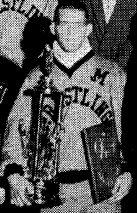
Myron Roderick with his first place plaque and team trophy. The trophy hides the A on his right shoulder to go with the M on his left.
In 1956 the title was close to locked up at the conclusion of the semi-final round. But not quite. The Aggies (Oklahoma A&M as Oklahoma State was known in the day) had a seven-point lead with five wrestlers in the final. The Sooners had three in the final. The 130 final was the only head-to-head between the Oklahoma powers. To win it all Oklahoma needed OSU to lose all five finals and win all three of their own finals. They almost pulled it off.
The Aggies finished Saturday night 1-4 while the Sooners were 2-1 (with a Hodge pinfall) to come within 3 points of the Sooners. Close, but no cigar. Roderick removed all doubt when he beat Lyons at 130. Maybe if he lost one of the three remaining finalists at 157, 167, or 191 would have dug deeper for the win. After all they lost by only 1, 1, and 2 points, respectively. Alas, the world will never know thanks to the man who would go on to coach the Aggies for 7 of their 34 (and counting?) team titles.
1952 Tommy Evans (Oklahoma) dec. Jim Harmon (Northern Iowa) 147 Final
and Jim Harmon (Northern Iowa) dec. Byron Todd (Oklahoma State) 147 Semi-Final
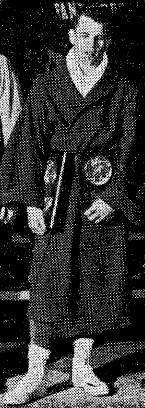
Can we agree that Tommy Evans makes a strong case for bringing the robes back?
In 1952 the top three team slots were all decided in the semi-final and final at 147. The top three teams were separated by two points. Oklahoma edged out Northern Iowa by a single point for first, and Northern Iowa edged out Oklahoma State by a single point for second. That order (Oklahoma #1, Northern Iowa #2, Oklahoma State #3) is the same order their wrestlers finished at 147.
It started with Harmon taking down Todd in the semi-final 2-2 with the referee deciding the winner (so unsatisfying). Todd would ultimately finish fourth. So, he technically had one more chance to pull OSU even with UNI in second, but could not pull it off, falling 4-0 to Michigan’s Miles Lee in the third-place match.
That possibility could only happen if Evans beat Harmon in the final. And he did. Evans eased to a 16-2 decision in the final (the major decision was still 24 years away).
1946 David Arndt (Oklahoma State) dec. Russ Bush (Northern Iowa)
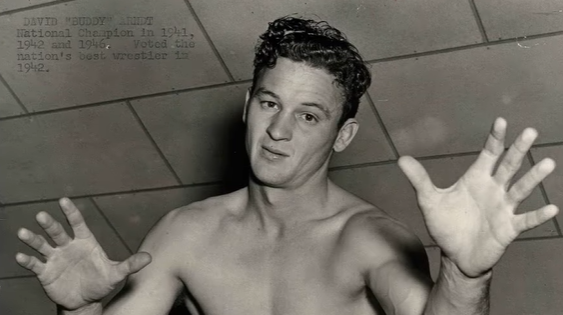
Do NOT let this GI get his mitts on you.
The GI’s had just returned home from World War II and Oklahoma State wrestling returned to the top of the heap. And David Arndt picked up where he had left off four years earlier by winning his third straight NCAA title while ensuring an OSU team title by knocking off Russ Bush in the 136 final, 8-3. That completed an undefeated college career for Arndt. And as near as anyone can tell, Arndt never lost. Not in high school, not in AAU, and not in college.
But those achievements pale in comparison to what Arndt achieved in the three prior years. According to his National Wrestling Hall of Fame bio, “Arndt spent the next three years as a P-38 fighter pilot, flying more than 100 combat missions over Italy with the 15th Air Corps. He was awarded the Distinguished Flying Cross and the Air Medal with Four Oak Leaf Clusters and collected six Bronze Battle Stars for action in major battles.”
Something tells me Arndt was not too bothered by the bright lights of the NCAA finals after that.
- Matburn lists the result as JD 1-1 (judge’s decision). (https://matburn.com/teams?team=67&person=94729
Matburn lists it as 1-1 JD….so maybe) ↩︎
Comment below.
If you have a question you want answered, data you want explored, or just want to say hello – wrestleknownothing@gmail.com
You can also follow me at wrestleknownothing.bky.social


Leave a Reply to GeneMillsFan Cancel reply