Every year there is a new crop of recruits and with them comes great expectations.
As wrestling fans we follow the news relentlessly. Who is visiting this week? Are we on the short list? Where do our commits rank? What do we think their title chances are? AA chances?
If a recruit fails to live up to our expectations it is all too tempting to label them a bust. But maybe the fault lies in our expectations. Not everyone can be the next four timer. Some cannot even be the next four time qualifier. But that does stop us from expecting, even if our expectations are unrealistic.
So I set out to figure out what are realistic expectations for a recruit.
Says Who?
These types of exercises are always fraught with danger. The truth of a wrestler is only known at the end of their career, but there is an entire industry dedicated to predicting that truth before they have wrestled a single minute of a single NCAA match. I am talking, of course, about the big board rankings. I use lower case here because there are multiple versions of these from multiple providers.
That statement right there tells you what you need to know about how true/accurate they are. If this were truth (it isn’t) we wouldn’t need more than one source of it (we do). One service can have Mitchell Mesenbrink ranked 59th while another can have him ranked 12th. Neither will be true in hindsight. But we have to start with something as a baseline to measure against. So…
For this exercise we will use Willie Saylor’s version of truth for the 2013 through 2020 high school graduating classes. The 2013 through 2019 classes are finished with their collegiate wrestling careers, and only a handful remain from the 2020 class, so we do not need to extrapolate. And in some cases we need to trim.
Wrong Every Time But Right On Average
One thing that jumps out in the data is there is a tremendous amount of volatility at the individual rank level but there is a strong overall pattern based on ranges of rankings. For most rankings you can group them in fives and make more sense of the data than by looking at individual ranks. Rankings 6 to 10 behave a certain way, relative to rankings 11 to 15, even if the relationship between 6 and 7 is a messy one (just ask your kids). The only place it makes sense to narrow the group size is among the top 5 ranks. Ranks 1 and 2 behave similar to each other and different from ranks 3, 4, and 5. For that reason the top 5 is split into two groups.
The Results
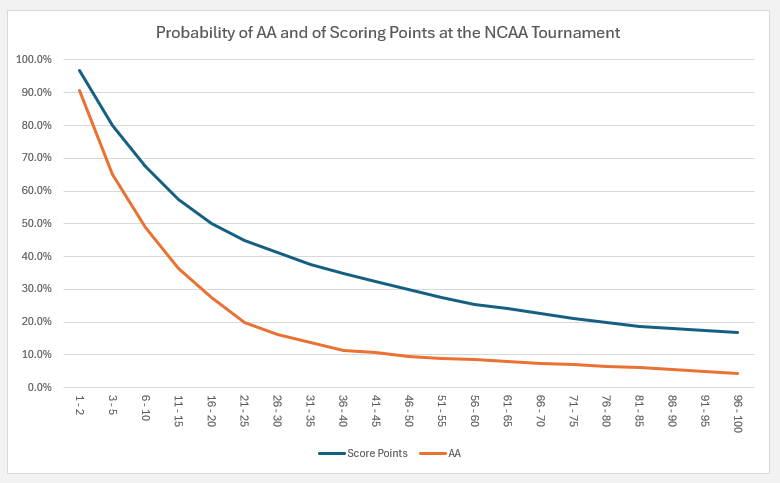
First, it is important to note that there is no such thing as a sure thing. But number 1 and 2 overall ranked wrestlers are pretty close. Among the eight number 1’s we examined, seven won at least one title with four of them taking home multiple titles. The number 2’s had three titlists, but they all won multiple titles.
And every wrestler from both rankings was a multiple time All-American. No other rank can boast that. But they were not all four time All-Americans (10 of 16 were) so the odds of becoming an All-American are only 96.9% for a top 2 ranked wrestler.
Of course, the real points come from being an All-American not just a qualifier. The odds of being an AA if you are a top 2 ranked wrestler are 90.6%. For wrestlers three through five the odds drop to 65%. Wrestlers six through ten are already below 50/50 (48.8%).
If you have a number 7 ranked recruit it is fair to expect them to score points at two or three tournaments on their way to two All-American finishes.
How Does That Translate To Career Scoring?
In a similar pattern, as you might imagine. From a high of 69.1 total points among the number 1 and 2 ranked wrestlers to a low of 2.9 points for the number 96 through 100 ranked wrestlers. Again, these are averages with a lot of volatility. Actual results may vary.
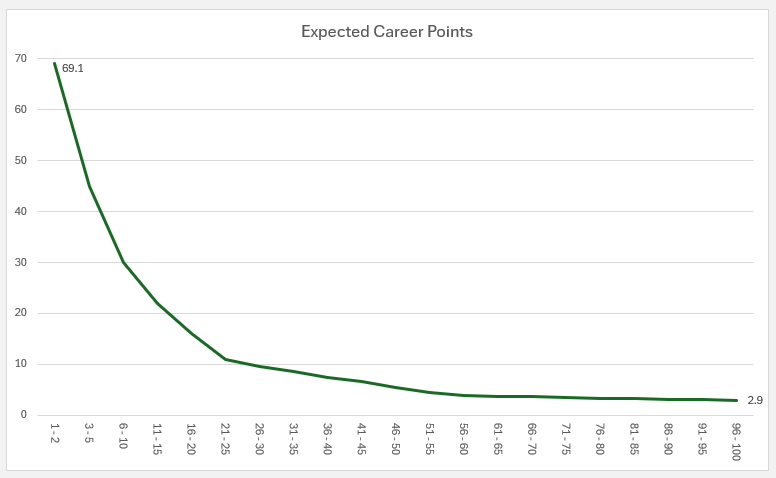
You can examine the details of the above graphs here:
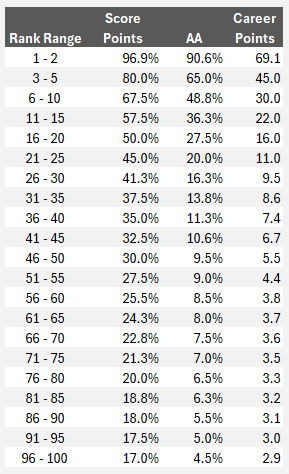
Actual Results
It can help to contextualize the data by attaching names to numbers. When thinking about these numbers who had a “typical” career? And who blew away the curve?
For a typical career I focused on who was closest to the average by ranking range. This is almost certainly not typical in that it will not also be the median result. But too often the median result is 0 times qualified – which is not very interesting. The guys who blew away the curve wind up pulling the averages up with them. So be it. I went with averages because the wrestlers are more likely to be memorable.
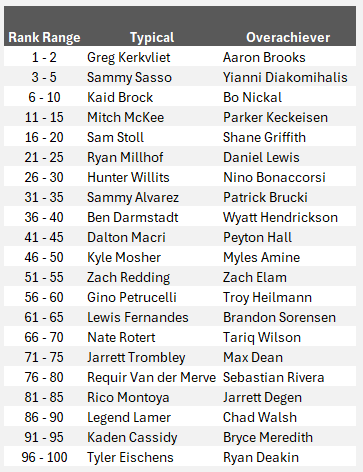
These choices are based on the first four years for a five year wrestler. That impacts guys like Greg Kerkvliet – who just about nailed the category average based on his first four years – and Carter Starocci – who got knocked out of the 6 – 10 range overachievers because Bo Nickal scored more points than Starocci did in his first four years. That Starocci won four titles to Nickals three in the same time period should count for something, but Editor’s Choice.
Of course, to drive people crazy I did the exact opposite with Yianni Diakomihalis. Even though Jason Nolf scored a lot more points I gave the nod to Diakomihalis anyway because four is greater than three.
Do I contradict myself?
Very well then I contradict myself,
(I am large, I contain multitudes.)
Comment below
Follow me at wrestleknownothing.bsky.com
Contact me at wrestleknownothing@gmail.com