Get out your dynamite and don’t forget your chisels. It is time to turn a mountain into a monument.
I was recently asked by jtothemfp of Black Shoe Diaries and BWI fame:
“The sculptor Gutzon Borglum (great name), who carved out Mount Rushmore claims that he chose the 4 Presidents to represent 4 different aspects of our great nation:
1. Founding / Birth = George Washington
2. Growth = Thomas Jefferson
3. Development = Teddy Roosevelt
4. Preservation = Abraham Lincoln
Should we sports fans also convert our largely “Top-4 / Best” usage of Mount Rushmore into these Borglum categories as well?”
Absolutely we should.
Note: For this assignment I am putting the emphasis on NCAA wrestling, but selectively including information beyond NCAA wrestling in the descriptions.
The Rushmores
Boy did I struggle with this assignment. There are so many worthy individuals who have made so many significant contributions to the sport in so many ways – wrestling, coaching, administration, promotion – that narrowing it down to just four proved a near impossible task for me. So I took the cowards way out. I didn’t do it.
Instead of one Mount Rushmore I decided to produce a mountain range of Rushmores. We shall call our range The Wrestlemores and it shall have three major peaks – one for wrestlers, one for coaches, and one for others. Of course, it is possible that one person could be on all three peaks (maybe that should be the fourth peak), and that is fine.
But it gets worse. Not only does my range have the three major peaks referenced above, but there is also a minor peak. Think of it as a first team Mount Rushmore and a back-up squad.
The only rule for making the range is the only rule my dad had when I was a kid.
Because I said so.
Though I did solicit the opinion of someone I respect tremendously. More on that to come.
Wrestlers’ Peaks
It make sense to start on the mat. Without the wrestlers what are we even doing here?
Founding – Major Peak Oklahoma State’s Earl McCready
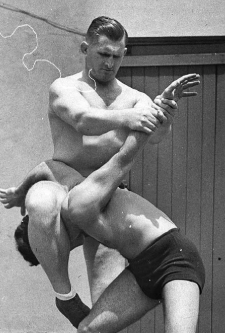
Can it be anyone other than Moose McCready? McCready dominated the college wrestling landscape from 1928 to 1930. His 19 second pin in the 1928 final is still the fastest on record in a final or semi-final bout. McCready was undefeated in those three years to become the first three-time titlist. And if there was a career Gorriaran Percentage Award McCready would likely have that too, with an 80% pin rate – not bonus rate – pin rate.
Founding – Minor Peak Oklahoma State’s Rex Peery
From 1933 to 1935 Peery took the mat 29 times and walked away the victor 29 times, with 16 by pin. But he also literarily founded a wrestling dynasty. With three individual championships of his own, three from his son Hugh (1952-1954), and three more from his son Ed (1955-1957) – both of whom he coached – he laid the foundation for an absurd family run of nine individual championships in nine attempts.
Expansion – Major Peak Iowa State’s Dan Gable
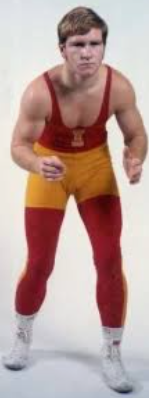
I originally had Dan Gable on the minor peak, but placing him on the second team was making me nervous. I just hope he never finds out. And when I reached out to noted historian and chronicler of wrestling, Mike Chapman, for his opinion on the matter he completely disagreed with me. For setting me straight I will give Mike the final say on Dan Gable.
“Gable has, in my opinion, a much larger impact through the great amount of airtime during the 1972 Olympics (with Frank Gifford gushing over him) and the many TV shows that followed. He was on such popular shows as “To Tell the Truth”, the “Dick Cavett Show” and “The Superstars”. He changed wrestling in terms of training and dedication and then changed the sport again as a coach. His impact extended far beyond wrestling when Tom Cruise said Gable was his hero in his youth, and when the president of the United States presented him with the Medal of Freedom in a White House ceremony.”
Pretty compelling. And this is from the guy who created the Hodge Trophy.
Expansion – Minor Peak Oklahoma’s Dan Hodge
Hodge was so dominant in the 1950’s as NCAA wrestling began its growth phase that the award for dominance is named for him. With 36 pins in 46 career matches Hodge had a 78.3% pin rate. But he really turned it up at the NCAA tournament where his pin rate jumped to 84.6% (11 of 13). Hodge also went to 2 Olympics prior to graduating college. After graduating high school and while in the Navy he took fifth at the 1952 Olympics and then took silver in 1956 while at Oklahoma.
Development – Major Peak Lock Haven’s Gray Simons
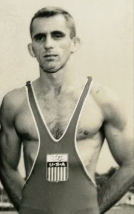
Gray Simons entered seven college national championship tournaments (four NAIA, three NCAA) and won seven college national championship tournaments. In six of them he was voted outstanding wrestler. But in the area of development is where he really shines. Simons was a graduate of Granby High School and would become the king of the Granby roll. He is credited with spreading the Granby series of moves across the college wrestling landscape. Since no one loves a Granby more than me, my sculptor shall roll with Simons.
Development – Minor Peak Oklahoma State’s John Smith
As the first American to be chosen Master of Technique by FILA who are we to ignore Smith’s contributions to the development of wrestling. While that award came after Smith’s collegiate years, make no mistake that the groundwork was laid by his legendary college habits. Smith’s mastery of the low single, and infinite variations off of it, made him the ultimate “we both know exactly what I will do, and there is still nothing you can do to stop it” wrestler of his age.
Preservation – Major Peak Iowa State’s Cael Sanderson
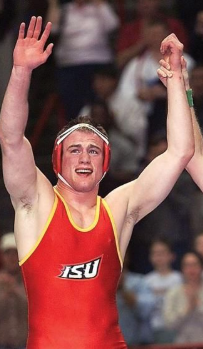
Say it with me. One hundred and fifty nine and zero. Zero. Since when is zero greater than one hundred and fifty nine? Since Cael Sanderson is when. Having the greatest wrestler in the history of college wrestling still alive and still involved goes a long way to preserving the sport.
Preservation – Minor Peak Cornell’s Kyle Dake
There is a real debate over which was more impressive – 159-0, or four championships at four weights with zero redshirts – and for that reason Kyle Dake makes my mountain. That he is still actively involved in the sport at the international level to this day puts him above the rest who would contend to be enshrined in granite. Four NCAA Titles, four World Titles, and four Pan Am Titles to go with two Olympic Bronze is an amazing list of achievements – and that list may still grow.
Coaches’ Peak
It is time to honor the men behind the men. Given the dynastic nature of college wrestling it is a little easier to exercise constraint in this category, so there will be a single major peak.
Founding – Oklahoma State’s Ed Gallagher
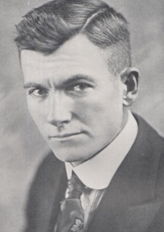
Having won 11 of the first 13 NCAA tournaments, the choice was simple. Gallagher was an engineer and athlete who chose to apply the former to the latter. The result was a scientific study of wrestling designed to maximize leverage and stress. The National Wrestling Hall of Fame credits Gallagher with the invention of more than 400 wrestling holds. But it is the first 11 reasons mentioned above that places Gallagher on our peak.
Expansion– Iowa State’s Harold Nichols
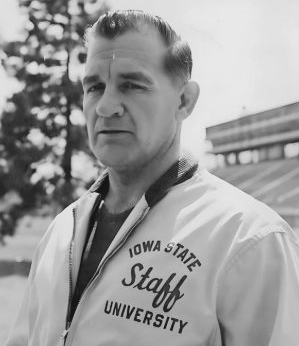
Dr. Harold Nichols coached more NCAA All-American wrestlers than anyone. Ever. With 82 wrestlers having earned 156 All-American honors, Nichols stands above all other coaches in both categories. But he also dominated at the team level. From 1965 to 1977 his Cyclones teams took home six team championships making Iowa State the dominant program for more than a decade as the sport saw its greatest growth.
Development – Iowa’s Dan Gable
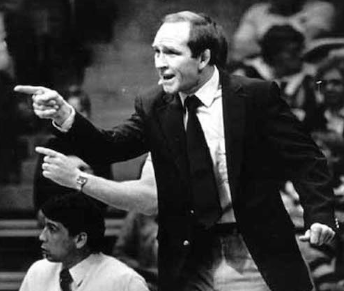
Iowa Style. Those two words are because of one man. What happens if you combine peak physical conditioning with unrelenting attacks and a grinder’s mindset? If you answered 15 team titles (most ever – along with 9 in a row, also most ever), all of the conference titles (21), 45 individual championships, and 152 All-Americans, you would be correct. After dominating NCAA wrestling, and international wrestling Gable returned to his home state to dominate collegiate coaching and then Olympic and World team coaching to boot.
Preservation – Penn State’s Cael Sanderson
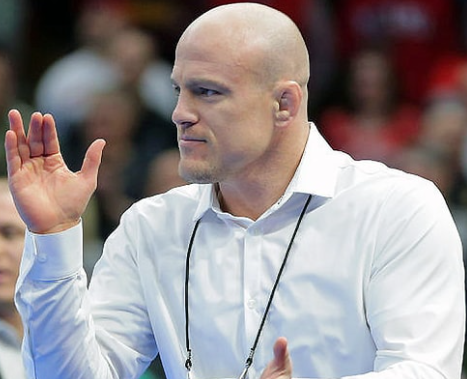
No coach had every produced an average of 2.2 NCAA champions per year – until Cael Sanderson came along. With 46 individual championships (the most ever) in 19 seasons of coaching Sanderson is averaging more than 2.4 champions per year. The scariest part is that the average has been on the way up recently – 3.7 per year for the last 9 years. And he is not doing too shabby on the team front either, having won 12 of the last 14 team titles, while setting and extending the team scoring record in three consecutive years. Crazy Stat: Sanderson’s 2024 Nittany Lions had a margin of victory (100 points) that was large enough to win two NCAA titles in the 2000’s.
Contributors’ Peak
Then there are the men behind the men behind the men. These gentlemen have done great things to advance college wrestling in ways that are not counted in wins and loses, but that are critical to the success of the sport none the less. Here to we have a single major peak.
Founding – Nebraska’s Raymond Clapp
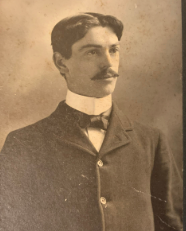
Dr. Raymond Clapp started the wrestling team at Nebraska, but his greatest contributions were broader than at a single university. Clapp was the chairman of the rules committee in the 1920’s that helped codify folkstyle wrestling as we know it today. He was also the driving force behind the creation of the NCAA Men’s Wrestling Tournament. These two foundational achievements for the sport are why his face is carved in our stone.
Expansion –Author/Historian Mike Chapman
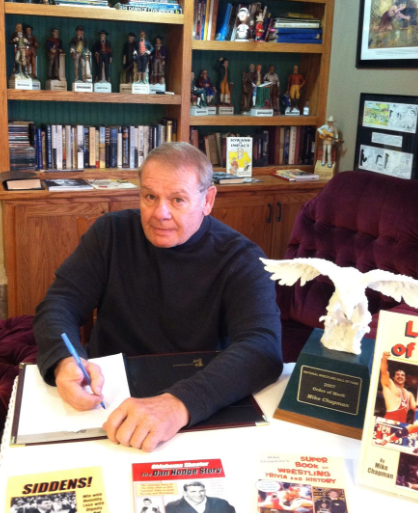
Author of 33 books (with a 34th on the way), founder of W.I.N. Magazine, creator of the Dan Hodge Trophy. This is a very partial list of Chapman’s achievements that speak to his contributions to the expansion of college wrestling. He was named the National Wrestling Writer of the Year five times and is a member of at least eleven halls of fame as well as the creator of, and former executive director of, The Dan Gable International Wrestling Institute and Museum. Chapman remains a tireless servant to the expansion and recognition of man’s oldest sport, having written a monthly column for WIN for the past 32 years, a total of 334 to date.
Development – Jairus Hammond
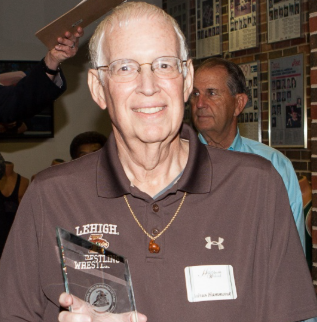
We all know it and we all love it. Jairus Hammond created the essential NCAA Wrestling Tournament database when he sat down to assemble, and put online, every tournament bracket beginning with the very first in 1928. He is also the author of the seminal book “The History of College Wrestling: A Century of Wrestling Excellence” published in 2006. While Hammond never wrestled he fell in love with the sport as an undergraduate at Lehigh University. But it was his decision to develop computer programming skills that resulted in the brackets on wrestlingstats.com that wrestling fans pour over to this day.
Preservation – Oklahoma State’s Myron Roderick
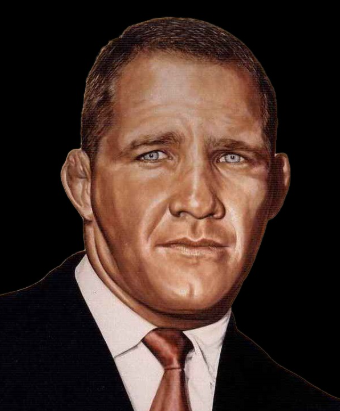
It may seem strange to reach all the way back to someone who wrestled in the 1950’s, coached in the 1960’s, and passed more than a decade ago as the face of preservation. But the National Wrestling Hall of Fame concept was originated by Roderick. Roderick was also one of the original six Governors (and the only wrestler on the Board) that bid for, raised money for, and built the Hall of Fame. Given the role in preservation that a Hall of Fame plays Roderick is eminently deserving of the award.
Behold The Majesty
Our mountain range is complete. Take a step back and bask in the glory. Quibble if you will, but my sculptor is a bit testy and he likes to quote Ozymandias:
Look on my works, ye Mighty, and despair!
Now this is our Mount Rushmore/Wrestlemore/Mountain Range. You might reasonably have another. And if you do, I would love to hear about it.
Comment on how wrong I am below.
Follow me at wrestleknownothing.bsky.social
Contact me at wrestleknownothing.gmail.com
7 responses to “The Mount(s) Rushmore of NCAA Wrestling”
Warren Tischler founder Resilite, The Mat Company.
Outstanding article!
Great choice. And here is his NWHOF bio for anyone who wants to learn more (https://nwhof.org/hall_of_fame/bio/117)
BTW, Shane Sparks would agree wholeheartedly. And thank you for the kind words.
Fantastic read. Really enjoyed everything about this piece. Thank you for putting it together.
That is very kind of you to say. Thank you.
This is fantastic to see! Mike Chapman has devoted his life to documenting and preserving wrestling’s rich history. His work has elevated the sport worldwide, and he’s truly earned his place as the world’s leading wrestling historian and author. Congratulations, Mike!
Amen.
Quality.