Last week the Division I Board of Directors directed the Division I Cabinet to advance a concept that would allow athletes five years of eligibility. Current athletes would be grandfathered in to the current rule set meaning they would not receive a fifth year of eligibility.
So What Might That Look Like?
Initially it would look a little something like it does now with some differences at the margin. Anyone covered by the 2025-26 rule set would finish their eligibility as they do now (presumably even including the ability to redshirt) while incoming freshmen would use up the first four of their five years.
An important difference is that for these four seasons the number of wrestlers vying for positions, both on teams and at the tournament, will rise steadily each year as the mix of classes with, and without, redshirts changes.
But by year five we will have five full classes of athletes competing for four classes worth of spots with no one taking a redshirt. That is different than the current situation where at any point in time a large number of wrestlers are taking shirts of varying colors and types. Things will start to get congested.
Or Will They?
One way to relieve the congestion is to share the wealth. Wrestlers who would have taken a shirt under the old rules might not want to sit a year and only get four years of eligibility when they can have five.1 For those wrestlers the grass may be greener elsewhere. Perhaps it will cause them to expand the list of schools they would have otherwise entertained. Of course, that would push another wrestler to expand their list, and so on, and so on. In this way the new rule has the potential to raise the competitive standing of all schools.
Alternatively, there may be a sub-set of wrestlers who are content with wrestling four out of five years. Those athletes might be willing to go to their room of choice knowing full well that it may result in reduced opportunities. After all, the reduced opportunities under the new rule may be at least equal to the opportunity available under the old rule.
But What About the Stats?
If not for the stats then why are we even doing this?
Amen. Of course we are doing this for the stats. Which got me thinking about how they might be impacted by this rule change. Right now the gold standard for wrestling excellence is being a four-timer.2 Will that be replaced by five-timer? What if you win the first four and lose the fifth? Or lose the first and then win four in a row? Will those achievements be as prestigious?
I have no idea. Nor does anyone, but it will certain be good fodder for wrestling forum arguments. I am more interested to understand whether it will happen as much. To get at that let’s look at the numbers first.
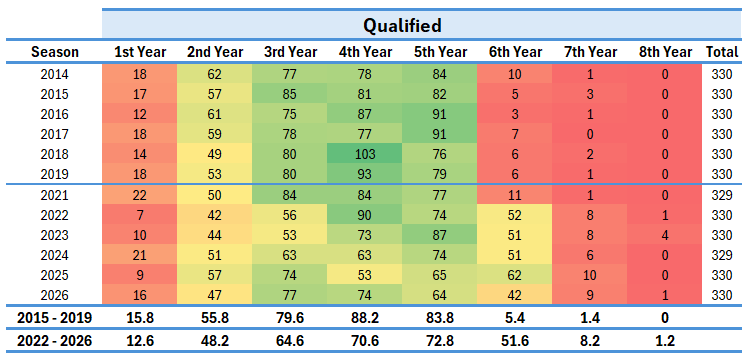
The table below breaks down the distribution of NCAA qualifiers by the number of years since their high school graduation for each of the last ten seasons. There is something that jumps out right away when you organize the data this way. The number of wrestlers who are six years removed from high school jumps dramatically in the 2022 season. I would have thought this occurred in the 2021 season, but it was delayed a year by the NCAA decision to not allow seniors to return after COVID.
PUBLIC SERVICE ANNOUNCEMENT
Let me pause here for a moment to recognize the Herculean effort Wrestling.Guru put in to assemble all of the data on this website that I have been fortunate enough to roll around in to produce my rambling musings. He does this on his own dime – for the love of the game, if you will. Maybe think about tossing a few shekels his way in recognition and support of what he is doing for the wrestling community. To donate: https://venmo.com/u/Robert-Thomas-441
Five is Greater Than Four
Now let us return to our regularly scheduled programming.
Another interesting fact is that across the last five tournaments there were only 68 true seniors among the 1,649 wrestlers, or 4.1%. The vast majority of wrestlers take at least one redshirt. Some take more. Beginning with the 2022 season we effectively have five full classes (selected from six graduation years) competing at the same time making the 2022 – 2026 time period somewhat comparable to what we will see going forward. This explains why true freshman representation has shrunk on average in the past five tournaments.3
But how do we redistribute those sixth year qualifiers in a 5 for 5 world? One assumption we can make is the 51.6 sixth year wrestlers will be ratably distributed across the other year categories under the new rule set. That would imply an average of 15.5 true freshmen per tournament – greater than the recent 12.6 and comparable to the past 15.8.
But it might also be fair to argue that the reason true freshman representation has fallen is because in 2022-2026 they are competing against four other classes instead of only three. If that is the case then the current status quo, with less freshman representation, may be maintained. I lean in this direction.
Impact – So Are We Getting More Four-Timers, Or What?
Let us return to the subject of four-timers. If there are fewer freshmen qualifying for the tournament it stands to reason that there will be fewer opportunities to win your first four tournaments. But that has rarely been the path to four-timer status. As a matter of fact, among the seven four-timers only Kyle Dake has done it this way.4
Now wrestlers will have two paths. Win the first four, or win numbers two through five. Effectively a mulligan is now available. But the mulligan can only be taken on the front end of the career. With redshirts a wrestler could hit pause at any point – but they had to get the point just right.
My guess is that with five classes competing at the same time it will be harder than ever to become a four-timer. But it will take a few years for the impact to be fully felt. And in that meantime we have four wrestlers who began the journey this year. There is a decent chance one of them will also finish the journey having reached the heights all four times.
But What Are The Chances?
I am glad you asked.
There have been 41 freshman champions in 95 tournaments. Four of the 41 happened last year. The jury is still out on them. Of the remainder, only 7 of the 37 went on to become four-timers. With a 19% historical hit rate, we may be lucky to see on of the 2026 foursome make it to the end.
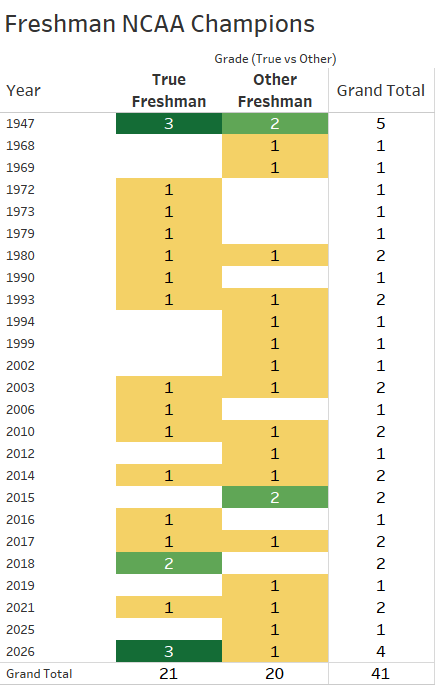
Before you pooh-pooh that notion take a good look at that table. In 1947 there were a whopping five freshman champions. And that was when there were only eight weights. And yet none of them went on to become four timers. Turns out this stuff is hard.
On the flipside it seems to be becoming easier. Between the 1946-47 and 1952-53 freshman eligibility windows, and the start of full time freshman eligibility in 1969, it took 26 tournaments before a freshman champ came along who could finish. Since then it has taken 9, 11, 2, 6, 2, and 0 years for a freshman to start a successful run at four.
If we focus on the narrowing gap from 26 tournaments to an average of 5, then the odds change a bit. With 6 four-timers resulting from the last 24 freshman champions the odds go up to 25%, and now we fully expect one of the 2026 class to finish, with a decent shot at two.5
Anyone Else Notice The Elephant?
There is certainly one in this room.
One benefit of giving everyone a shot at five championships is we will finally know what to say about Carter Starocci. By we, I mean me. And by say, I mean analyze statistically – you know, my first love.
In the past I have made the claim that no one serious takes five seriously. That statement has not gone unchallenged. But I remain steadfast that it is impossible to know what the other six four-timers would have done if given a fifth bite at the apple.
Winning five does not necessarily raise Starocci above Smith, Sanderson, Dake, Stieber, Diakomihalis, and Brooks given the latter group’s lack of opportunity to match. It would be silly to argue that they all would have won a fifth.
But surely at least one would have.
Comment below
Contact me at wrestleknownothing@gmail.com
Follow @wrestleknownothing.bsky.social
- Heaven forbid they get injured and lose another year of eligibility. ↩︎
- Please do not email me to tell me about Carter Starocci. ↩︎
- That is not to say true freshman success has declined. The 2026 tournament showed that the true freshman who make the Big Dance outperform their modest numbers. ↩︎
- Can we give Aaron Brooks an asterisk on this one since the decision not to go his freshman year was not his own? And I will return to address Carter Starocci. ↩︎
- Depending on how you feel about recency bias you can also argue 3 of the last 6 freshman finished with four (or more) and now the expectation is 2 with solid chances of 3, or even all 4 winding up with four. ↩︎
4 responses to “5 in 5 – What Might That Look Like?”
Thank Brother. As always…
right back at ya, brother
Great content and effort as well!
Thank you for the kind words