FloWrestling’s Kyle Klingman recently wrote an article examining NCAA tournament scoring anomalies (Is 3rd Better Than 1st…). One of the main concerns expressed in the article is that third place can outscore first place – and did this year at 157, where third place PJ Duke took home 20.5 team points while first place Landon Robideau only scored 20 team points.
The reason of course is bonus points. There are more rounds in the consolation bracket, creating more opportunities for scoring. The solution proposed was to cut consolation bonus points in half to mirror what happens with advancement points. Before assessing the solution, though, we should quantify the problem.
The Modern Scoring Era
The current combination of placement points, advancement points, and bonus points has been in place since 2001. By then bonus points were already fixed at 1 point for a major, 1.5 points for a tech fall1, and 2 points for a pin. Similarly, advancement points had been fixed at 1 on the championship side and 0.5 on the consolation side since 1974. But in 2001 placement points were shifted 1, 2, or 3 points higher for third through eighth.
For this reason, for the rest of the article we will confine our analysis to the 2001 – 2026 time period.
How Big Is The Problem?
Let’s start by looking at the frequency of the problem.
The below table shows how often any given finisher is outscored by any All-American finisher below them. For a wrestler finishing first, that is any wrestler finishing second through seventh. For a wrestler finishing second, that is any wrestler finishing third through eighth. And so on.
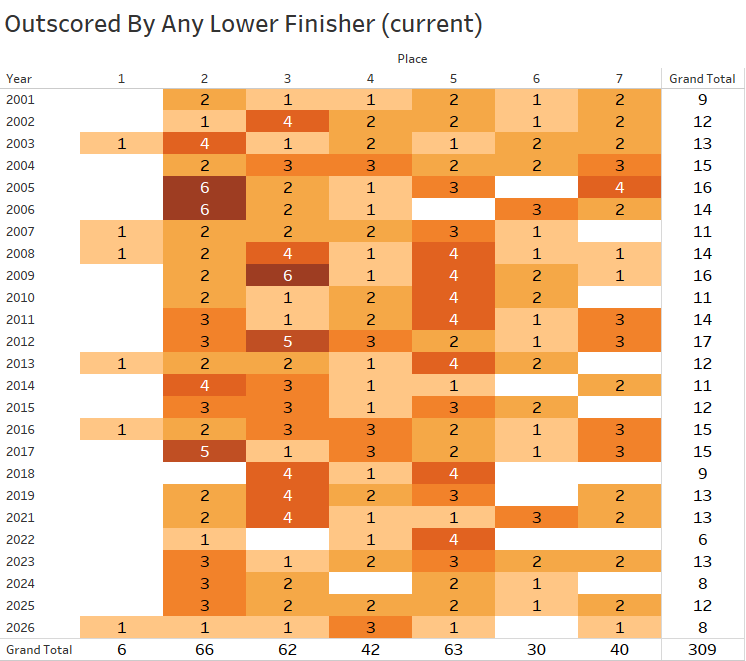
In the past 25 tournaments an All-American has been outscored by a lower finishing All-American 309 times. With 7 comparisons per weight (there are no lower AA’s to compare eighth place to), there are 1,750 observations over our 25 tournaments, meaning 17.7% of the time an AA is outscored by someone further down the podium.
It happens least frequently with first place finishers, only 6 times (2.4%), and most frequently with second place finishers (26.4%).
This makes perfect sense. The largest placement point gap is between first and second, making it more difficult to overcome with bonus points. And while second enjoys a similar placement point advantage as fourth and sixth, it is offset by the fact that the second place winner has rarely ever won more than four matches in our window (comment below if you can name the five wrestlers who won five matches on the way to a second place finish – or the three who only won three).
With fewer wins come fewer opportunities for bonus.
Right away we can see the opportunities for injustice are very rare at the top. The real problem, by an order of magnitude, exists at second, third, and fifth place – with smaller, but still significant chances, at fourth, sixth, and seventh.
That sixth and seventh are so low on the list also makes sense as there are only two and one wrestlers, respectively, to contend with that finished lower.
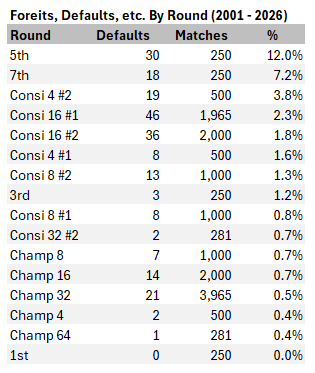
The real surprise in the group is fifth place. Fifth place is probably the biggest beneficiary from the semi-final loser forfeiting/defaulting out of the rest of the tournament, and gifting them two bonus points in the process. And in fact it happened 12% of the time (30 of 250) – by far the highest rate of any round.
And How Big Is The Fix?
In the Flo article a simple solution was proposed.
The solution is simple: cut all bonus points in half on the consolation side. This places a premium on winning championship matches, ensuring that third place doesn’t score more points than first.
First a niggle.
Cutting bonus points in half on the consolation side may make sense, but it absolutely does not ensure a lower finishing wrestler of any kind will not outscore a higher finishing wrestler – never mind ensure that a third place wrestler will not score more than a first place wrestler. And we see that in practice.
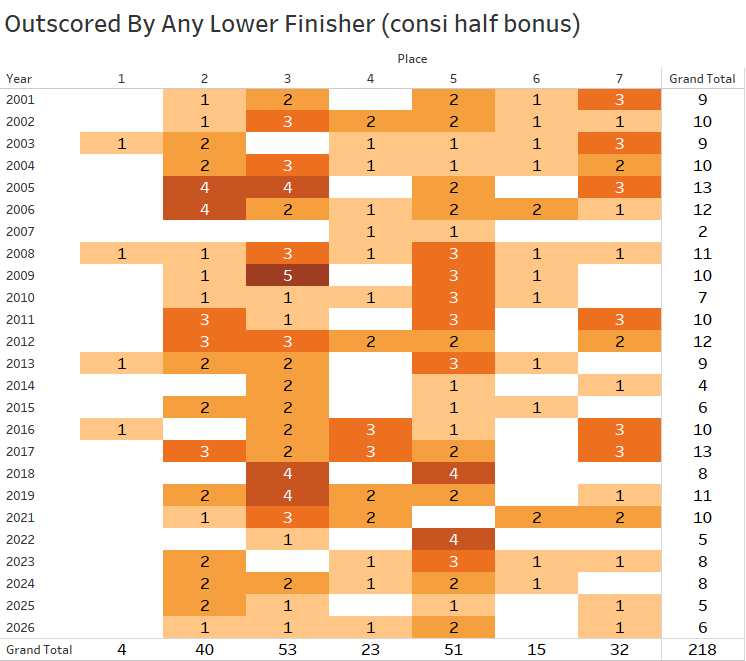
It is a simple exercise to rescore 2001 – 2026 with consolation bonus points cut in half. The below table shows the results of that exercise with respect to a higher finisher being outscored by a lower finisher.
We have certainly made progress.
From 309 instances using current scoring, we are down to 218 using reduced bonus scoring, but that still represents 12.5% of observations. And when we dig into the detail it is not the clean reduction we were hoping for.
- 111 instances of a higher finisher being outscored by a lower finisher were eliminated.
- But 20 new instances of a higher finisher being outscored by a lower finisher were introduced.
- There are 22 instances of the first place finisher scoring 20 points.
- There are 23 instances of the third place wrestler scoring more than 20 points – even after halving consolation bonus points.
The Real Simple Solution
The only way to ensure third place does not outscore first place is to eliminate bonus points altogether.
Let that sink in.
This is a perfect example of the cure being wore than the disease. We are in the midst of a failed experiment to promote more action and risk taking (The 3-Point Takedown) that has led to an all-time high in zero and one takedown matches. Do we really want to eliminate any incentive at all to score points?
If we eliminate all bonus points we might as well start all matches in overtime. Never mind. That wasn’t simple at all.
Quit Being Silly
Come on. No one would seriously propose eliminating all bonus points. Heck, Flo did not come anywhere near that level of silly. As a matter of fact, the Flo proposal was perfectly rational. But we need to be prepared to have this same conversation again the year after consolation bonus points are halved because it only slightly mitigates the problem. It does not solve it.
But there is another way.
If the spread between placement points was increased, the frequency of lower finishing wrestlers achieving enough bonus decreases proportionally.
And if we combine the two solutions – increasing placement point differentials and halving consolation bonus points – we make even more progress.
Before anyone pooh-poohs the notion of increasing the spread of first place placement points over all the others it would be good to look at some history.
The Devaluation of First Place
When I was your age we had to walk uphill both ways to everything, and first place really meant something. In the early days of NCAA tournament wrestling first place constituted a significantly greater share of points than it does today.
From 1928 until 1940 placement points for first represented almost 56% of non-bonus points scored (back then there were no advancement points). By 2026 that share was below 18%. And with few exceptions the drumbeat has been fairly constant – first place has almost always been devalued.
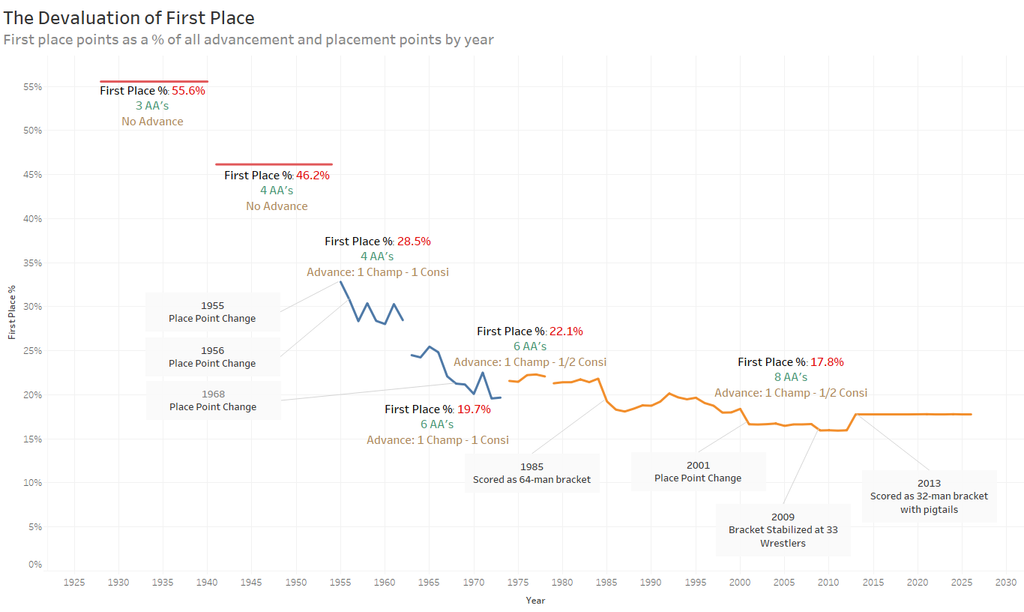
The percentages in red are the share of placement and advancement points for first place placement points at the end of the respective period.
Dude, Where’s My Points?
How do we account for the 37.8% drop in scoring share for first place between 1928 and 2026?
The reasons for the decrease can be divided into three approximate categories:
- 14.2%: Expansion of All-Americans and Associated Placement Point Changes –
From three to four, to six, to eight AA’s, with more ways to score the old ways become diluted. - 4.5%: Stand Alone Placement Point Changes –
On a few occasions placement points have been altered without any other associated changes, further diluting first place. - 19.1%: Advancement/Bonus Points and Bracket Size Changes –
These two changes compliment each other. Bigger brackets lead to more opportunities for both advancement and bonus.
Working from largest historic impact to smallest, advancement points have already been dealt with when they were halved on the consolation side in 1974, and bracket sizes stabilized in 2009 at 33 wrestlers – no one wants to shrink it either. While these effects have accounted for the largest amount of devaluation, it doesn’t feel like there is much, if anything to do here.
Expansion of All-Americans and associated placement point changes is unlikely to reverse. There is just no way we are going to decrease the number of All-Americans unless there is a large decrease in the number of programs. Shhh. Sush. Let us never speak of this again.
Stand alone placement point changes only account for 4.5% of the change, but probably hold the most promise. If we have compressed the differences in the past, why can’t we expand them now? Roll back the clock.
One big caveat though is that if the goal is to eliminate all possibility of the third place wrestler surpassing the first place wrestler’s point total there would need to be a minimum increase in first place of 10 points without any increase in third place2.
Do we really want first worth 26 placement points, second worth 12, and third worth 10 points? Don’t answer that.
But if we decreased bonus points in the consolation bracket by cutting them in half then we only need to increase first place placement by 4 points to 20 to make it impossible for a third place finisher to surpass a first place finisher. Hmmm.
An Alternative Solution
Let me propose a radical solution. Score more bonus points.
First place finishers tend to have high seeds. Wrestlers with high seeds have easier paths. Easier paths create more bonus point opportunities. I suggest taking advantage of those opportunities. The fault isn’t with the third place wrestler, or even the scoring system. The fault is with the wrestler who doesn’t get bonus points.
Like I mentioned above, we already have a rule change that is discouraging takedowns. Let’s not add to the problem by lowering the hurdle.
Besides, among the 6 instances where a first place finisher has not scored the most points at their weight in the last 25 tournaments, only 1 of those involved the third place finisher outscoring the first place finisher. And even then it was by a half point. I am not a fan of rule changes based on a 1 in 250 event. Never mind a rule change that would also discourage risk taking and scoring.
That said….
I get the logic of cutting consolation bonus points in half.
Comment below (especially if you know the answer to the trivia question.
Or email me any time at wrestleknownothing@gmail.com
- From 2001 to 2015 there were two kinds of tech falls – with back points, and without back points. Without back points was only worth 1 bonus point. ↩︎
- The championship pigtail loser goes into the consolation pigtail creating the possibility to win eight straight matches by pin and picking up 16 bonus points. ↩︎
4 responses to “Orange is the New Black and Third is the New First”
I’ve always been curious as to why the consi bonus points were the same as the championship bonus when the advancement was halved. Always thought the bonus should match that.
I do not have a good reason for that, but I would note the timing differences. Advancement points in the consolation bracket were halved in 1974. The major was not introduced until 1976 and the tech fall came along 9 years after that. But what I do not understand is that when they doubled bonus points in 1995 why they did it on both sides of the bracket given the precedence they set with advancement. Would love to see the reasoning at the time.
I have commented multiple times on this wrestling forum (and the TheMat.com prior) over the last 15 years asking why Bonus points weren’t halved in Consolations to match Advancement points. I never received a response on why it is or why it is sensible or why it’s a justified means for Team Scoring. A real anomaly that nobody in the College Wrestling world seems to care about.
Show_Me, I remember you from TheMat/Intermat. I have looked on a couple of occasions for the rationale, but cannot find it. Now, when they make a rule change there is a document with the rationale. Maybe they didn’t do that back then. Or maybe they did, but no one has thought to put it on the internet. Or maybe I am just bad at finding it.