
But Is It Working?
The year was 2023 and there was a plague upon the land of folkstyle wrestling.
Scoring at the NCAA tournament was down – a lot. After hitting a near-term peak in 2017 overall scoring declined nearly 6%, driven by a 24% decline in bonus points. Cagey, low scoring decisions ruled the land. From 2017, when decisions hit an all-time low in the modern scoring era, they had ballooned to an all-time high by 2023. Something needed to be done.
A committee of learned gentlemen was assembled. At the NCAA Wrestling Rules Committee Annual Meeting a decision was made. Increase the value of a takedown from 2 points to 3 points. The stated rationale (linked here) was:
“to better reflect the skill and energy required to secure a takedown. Increasing the points awarded will incentivize wrestlers to take additional risk in the neutral position, providing increased opportunities for both offensive and defensive takedowns.”
Increase risk taking. Increase takedowns. Laudable goals each. But how did we do?
Three Years of Three Points
Now that we have three years of NCAA tournament data we can begin to assess whether the remedy was effective in solving the problem. Has there been more offensive action and risk taking? For this exercise lets start by looking at the shift in share of result types: DEC, MD, TF, and FALL. But first we need choose our window for analysis.
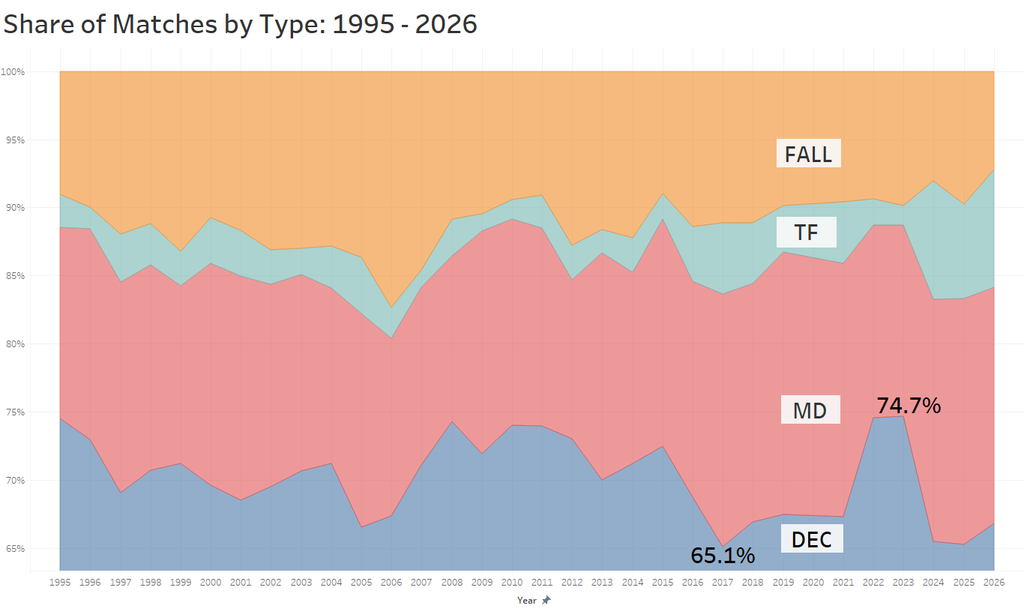
As can been seen in the graph above these comparisons are very dependent on the timeframe chosen. If you focus on the share of decisions in 2022 and 2023 you get a very different answer than if you expand the 2-point comparison window just one or two more tournaments to 2021 or 2019.
If we assume that the committee’s actions were driven by the spike in decisions in the 2022 and 2023 tournaments, this is a fair starting point for our analysis. It is also a conservative way to look at the data. Expanding the window backward to include more years mutes the problem the committee sought to fix. The 2022 and 2023 tournaments represent the lowest hurdle for our analysis. No other contiguous time period saw less action.
Migratory Patterns of Wrestlers
The chart below requires some explanation.
The numbers in black against the white background are the percentage of matches that ended in a particular type (DEC, MD, TF, PF) from 2022-2023 – our baseline. The numbers in red or green are the migration from (red), or to (green), a different match type between the 2022-2023 time period and the 2024-2026 time period. The numbers in white on the far right are where the percentages settled from 2024-2026, and are the sum of the numbers to their left.
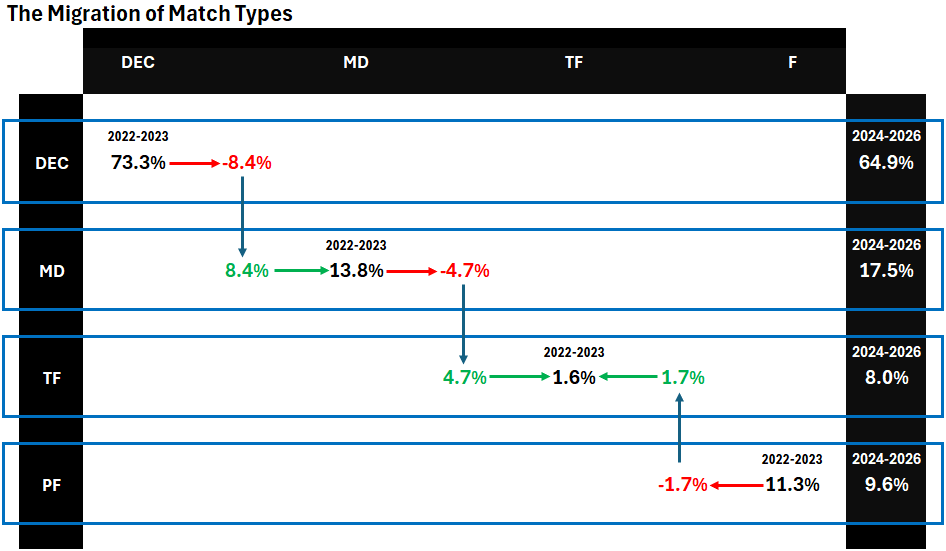
- Decision: 8.4% of Decisions migrated to major decisions pushing the total decision percentage down from 73.3% in 2022-2023, to 64.9% in 2024-2026.
- Major Decision: While Major Decisions received an 8.4% contribution from Decisions, the category also made a 4.7% contribution to tech falls. The net change brought majors up from 13.8% of match results in 2022-2023, to 17.5% in 2024-2026.
- Tech Fall: While Tech Falls received a 4.7% contribution from Majors, the category also received a 1.7% contribution from Falls. The net change brought Tech Falls up from 1.6% of match results in 2022-2023, to 8.0% in 2024-2026.
- Fall: 1.7% of Falls became Tech Falls pushing their total down from 11.3% of match results in 2022-2023, to 9.6% in 2024-2026.
When we say one match type became another match type that is not literal. But you can see the mechanism. What would have been a seven point win in the 2-point era becomes a win by eight, or more, in the 3-point era – all other things equal. A similar logic is assumed for majors becoming tech falls. But where things are more interesting is the movement from pins to techs. Why would that be? One explanation would be that with techs coming faster – due to requiring fewer takedowns – time is lost to work on the pin.
Grading The Change
The net result of all of this movement between match types can be measured by the dominance score. The dominance score is typically used in Hodge Trophy discussions, but can be useful here too. By scoring each result with dual meet values (6 for a fall, 5 for a tech, etc.) and taking a weighted average we can reduce the impact of the rule change to a single variable.
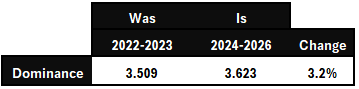
Between the increase in majors and tech falls, and offset by the decrease in pins, we wind up with a 3.2% increase in the average dominance score. Which seems…..not that much?
Yes, there are a lot more tech falls and yes, the dominance score has increased, but is that just due to score inflation? Or is it due to more risk taking and increased opportunities for takedowns – the stated rationale?
At this point, we have to give the committee an incomplete grade. We need to dig a little deeper to measure the results against the rationale.
Have You Made Your Decision For Offense?
Here we need to make a confession. We do not have access to individual match scoring actions. My kingdom for such a database. With that kind of information we could perform a very direct analysis of whether there are more takedowns. Absent that data we need to come at this a little less directly.
One place we can analyze with some confidence is the decision match type. There are certain score lines that we can make definitive statements about. It helps that these are also the score lines we hate. They are the bane of our wrestling existence, and the reason the committee chose to act in the first place.
Of course we are talking about the zero or one takedown decision1. The “let’s just start this thing at 1-1 in OT” type matches that we have all come to know, and mostly detest. These matches are the opposite of what the committee was going for. No one takes any risk and scoring opportunities are at a minimum. Maybe the opportunities never come at all. Maybe we just take this thing to rideouts, and make sure everyone leaves unsatisfied.
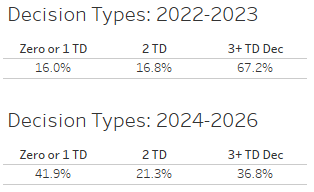
We can break the decisions down into smaller categories based on the number of takedowns implied by each wrestler’s score.
Oof.
Zero or one takedown matches used to represent just 16% of all matches that ended as a decision. Now that we have a 3-point takedown they represent almost 42% of all matches that end in a decision – a 162% jump. To quote the anonymous couple on the right side of the road in Planes, Trains, and Automobiles: “You’re going the wrong way.”
Now, you could niggle about my definition of what constitutes a zero or one takedown match in the 2-point era. I define it as a score line that clearly fits the category. The winner has 3 or fewer points, the loser has 0 or 1 point. But there were a few ways to get a fourth point as the winner, or a second point as the loser, without a takedown. This is the weakness of an indirect measure.
But to even out the percentages you would need to expand the definition of a one takedown match in the 2-point era all the way to 5-3. And that is only if you do not perform a symmetrical expansion of the definition in the 3-point era. We just can’t get there from here.
For those who want to try – the breakdown by score lines with the winning score on the vertical axis and the losing score on the horizontal axis:
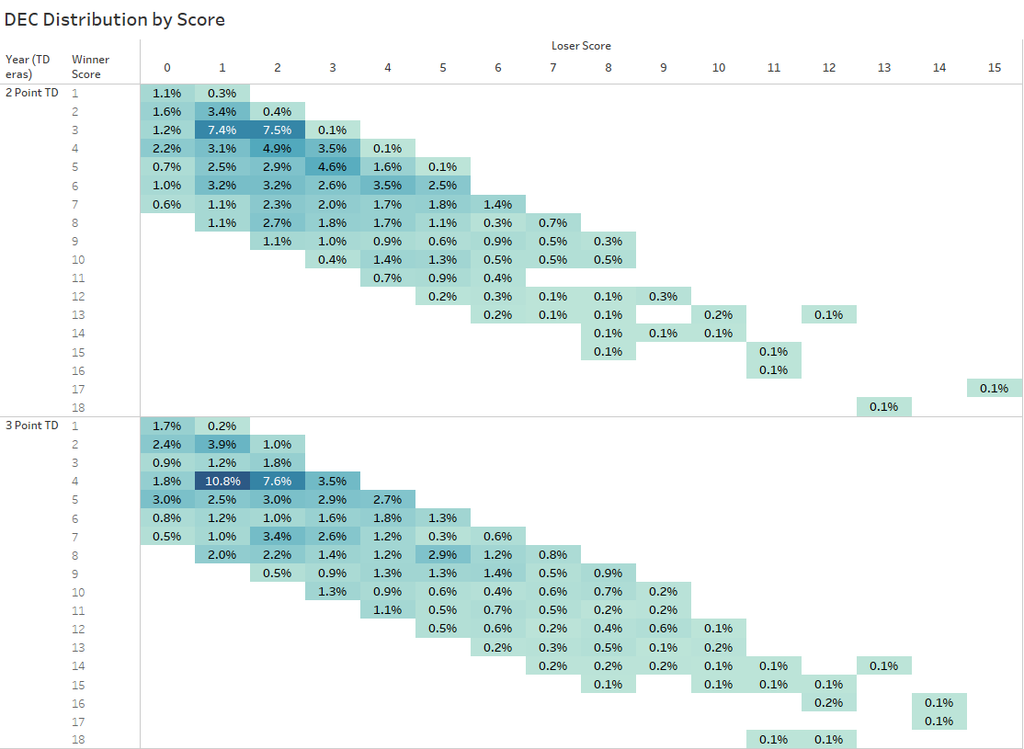
A couple points about era-equivalent scores in this table:
- 3-1 in the 2-point era is the equivalent of 4-1 in the 3-point era – it has grown from 7.4% of decisions to 10.8% (+46%).
- The 3-2 and 4-2 pair has grown from 7.5% to 7.6% .
- Winning with a single point has grown from 1.2% to 1.9% (+58%).
The grade on the 3-point takedown is starting to lean negative.
If You Have Come This Far….
Perhaps you are willing to go a little further. Let’s take this to overtime.
Another element we can examine is the occurrence of overtime matches.
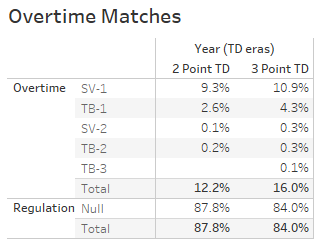
Prior to the 3-point takedown 12.2% of decisions went to overtime. Now it is up to 16% of decisions. It seems more people are wrestling for fewer takedowns. We have more matches with a single takedown or less, and more matches going to overtime. The trend is not our friend for the 3-point takedown.
What is the opposite of extra credit? Whatever it is, it is accumulating. We feel comfortable giving the 3-point takedown a failing grade at this point.
But Why?
Why are there more low scoring and overtime matches than in the past? Here all we can offer are theories.
Theory 1: Blame the 3-point takedown.
I suspect this will be a popular theory. We certainly have correlation. As for causation, we have all seen the strategy adjustment play out before our eyes. Because of the relative point value change, a single takedown to break a tie at, or near, the end of the match becomes exponentially more valuable. And it doesn’t matter if it is 1-1 or 10-10. There are two reasons for that.
Reason 1: Simple math. If a wrestler scores a takedown and gives up the escape near the end of a match they have a small lead – 1 point in the 2-point era, and 2 points in the 3-point era. The strategy then becomes to bleed the clock even at the risk of taking stall calls. Run in circles if you have to, but whatever you do, do not engage. With a 1 point lead you can only afford to take a single stall (or none if you already have 1 or more). But in the 3-point era you can now extend your sprint if you have the cardio. You can take 2 stall calls and only give up a single point (or 1 if you already have 1 or more). And this is where reason 2 comes in.
Reason 2: Human Nature. We all want the wrestlers to decide the winner on the mat. This makes referees hesitant to make stall calls in high leverage situations where they might be deciding the outcome. Or at least they would be accused of deciding the outcome by fans. It is really the stalling wrestler who is deciding the outcome. And the referee is just taking note of it – officially. But that kind of rational thought is in short supply at the end of a match (and often any time during a match – or afterward on forums, especially on forums). The cynical wrestler takes advantage of this fact when they lace up their skates with a two point lead and no stalls. While the wrestler may deserve three stalls in the final thirty seconds, it is a safe bet he wont GET three stall calls against him in thirty seconds. We have all seen it. Run for 20 to 24 seconds because the first stall will come with 6 to 10 seconds left. Just in time to be meaningless.
Theory 2: Massive Improvements in Defense.
If improvements in defense coincide with the move to the 3-point takedown it would be easy to mistake the real cause. There has definitely been a shift in strategy over time. If someone gets to your leg that isn’t the end. That is just the beginning. Dive over the top. Grab an ankle. Sit the corner. Lock through the crotch. Work to get around behind. Worst case scenario, wait for the stalemate. More and more, it seems, we see promising looking shots turn into nothing or defensive scores. Either way there is a great expenditure of energy by the attacking wrestler without the expected reward. I get exhausted just watching it. I cannot imagine how the wrestlers feel. So I can understand a resistance to shoot unless the set up is perfect. And it is never perfect.
Theory 3: Kobayashi Maru
When presented with a no-win scenario, change the conditions.
There seems to be a spike in finger grabbing/locking. And it does not matter how often or how long one wrestler shakes his wrist violently to signal to the ref “hey, see what is happening with the fingers?” it is allowed to happen over, and over, and over, and over….you get the point. And unlike with theory 2, it is not a defensive scoring strategy. It is just a way to prevent action while seemingly presenting yourself. In that way it plays heavily on reason 2 above. The cynicism of daring the ref to insert themselves into the match and “do something about it” is generally not punished.
So Which Is It?
If you ask me – and you just did – I think the answer is yes.
I see elements of all three theories playing out. BUT, what makes theory 2 (great defense) and theory 3 (disguised stalling) so effective is theory 1 (blame the 3-point takedown). By expanding the difference between a takedown and a stall it has created a backward incentive to create less action until the very end. And then half the action is inaction. This is at least a little ironic. It is an example of the law of unintended consequences playing out.
While not stated in the committee notes referenced above, the NCAA released an article at the time with an additional reason for the change.
“The committee also agreed there was a need to create a more appropriate point differential between takedowns and escapes and incentivize offense when competitors are in the neutral position.”
The committee’s focus on the difference between takedowns and escapes caused them to miss the countervailing difference between takedowns and stalling. As the data above suggests – but does not prove – it looks like the spread to stalling was a more powerful incentive structure than the spread to escapes. Stalling has been made more profitable. Dare the ref to call the stall – because he probably wont.
Up is Down
This presents an interesting thought experiment. If increasing the spread between takedowns and stalling is counterproductive to action, would decreasing the spread have the opposite effect? If we make a takedown worth 1.5, instead of 3 or 2, would wrestlers wrestle more?
If a wrestler has a half point lead after a takedown and an escape they can still lose to a pair of stall calls against them. At this point, with a single takedown, stalling is not a profitable strategy. It only becomes profitable if you increase the lead by getting more takedowns. To make inaction a viable strategy it has to first be preceded by a bunch of action.
Maybe it would work, or maybe there are other unintended consequences to deal with. I will let the reader decide.
And debate. Comment below or reach out at: wrestleknownothing@gmail.com
- Zero or one takedown matches are defined as follows. For the 2-point TD era any match where the winner has 0, 1, 2, or 3 points and the loser has 0, or 1 point. For the 3-point TD era any match where the winner has 0, 1, 2, 3, 4, or 5 points and the loser has 0, 1, or 2 points. ↩︎


Leave a Reply to Michael Chiaverini Cancel reply