
I have been asked in the past what happens to older wrestlers. I have never been able to answer that question satisfactorily. Until now.
Depending on your partisanship you are likely to argue either side of the question. For every sixth or seventh year guy that finally breaks through there is one that breaks down instead, like an old draft horse. Or so it would seem.
Now that we have the data we can decide whether it is better to get on with one’s life, or Peter Pan this thing. To figure this out I joined the individual match results on our matches data page (https://wrestling.guru/college-men/ncaa-d1/ncaa-d1-championship-matches/) with the high school graduation data on our championship data page (https://wrestling.guru/college-men/ncaa-d1/ncaa-d1-database/). After narrowing things down to the 16+ seed era (2014 – 2025) I grouped results by approximately eights (1st – 8th, 9th – 16th, 17th – 24th, 25th – 32nd or higher).
Because class designations (freshman, redshirt freshman, sophomore, etc.) have become such a mess I am using the number of years since the wrestler graduated high school to group wrestlers. This means any wrestler in the 1 year category is a true freshman, but a wrestler in the 2 year category could be a red/grey shirt freshman or a sophomore. The permutations grow as the years increase.
This table shows the progression:
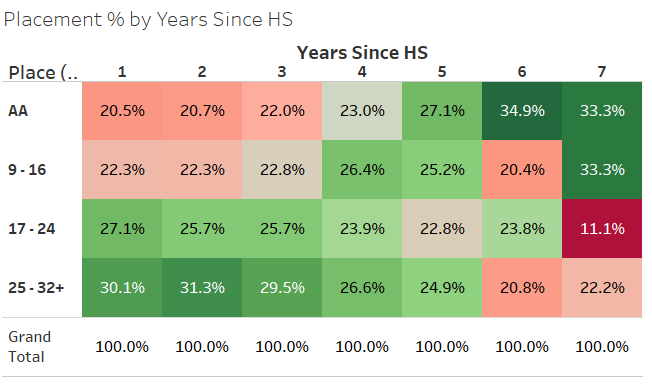
The progression is pretty clear.
- As a true freshman the most likely outcome is 0-2 BBQ….with experience gained.
- By year two pretty much nothing has changed. What have you been doing with your time?
- But year three begins the steady migration, with a slight bump in the odds of becoming an All-America. Finally something to show for all that work.
- By year four almost any outcome is as likely as any other.
- In year five things begin to take off with a podium finish the most likely outcome.
- Year six is the sweet spot with a better than 1/3rd chance of parading with the other AA’s. Haters be damned, the hair dye seems to be working.
- Year seven is not quite the victory lap you expected, there are a few more aches and pains, but still pretty darn close. Though an 0-2 finish is twice as likely as a 1-2 finish.
Because there are different numbers of qualifiers for each ‘years since high school’ category I showed the number as percentages of the column above. Below is what the raw numbers look like with the color still based on percentage of the column.
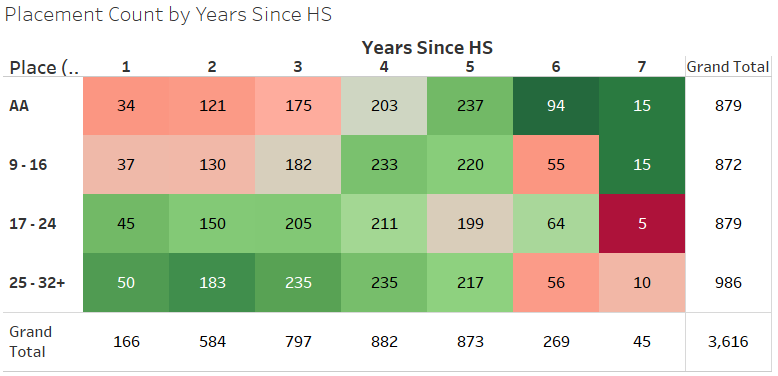
The keen eyed observer may notice that the total number of wrestlers above is slightly less than the total who participated in the tournament. Turns out we are missing a few high school graduation years. (If you know any of the missing ones, speak now…)
Finally we come to average placement by years of experience. This is an attempt to distill each column above into a single number. For this I treated a non-AA finish as being at the top end of the range. For a blood round elimination the wrestler is credited with 9th place, the four who lose in the consolation quarters first round are credited with 13th. And so forth.
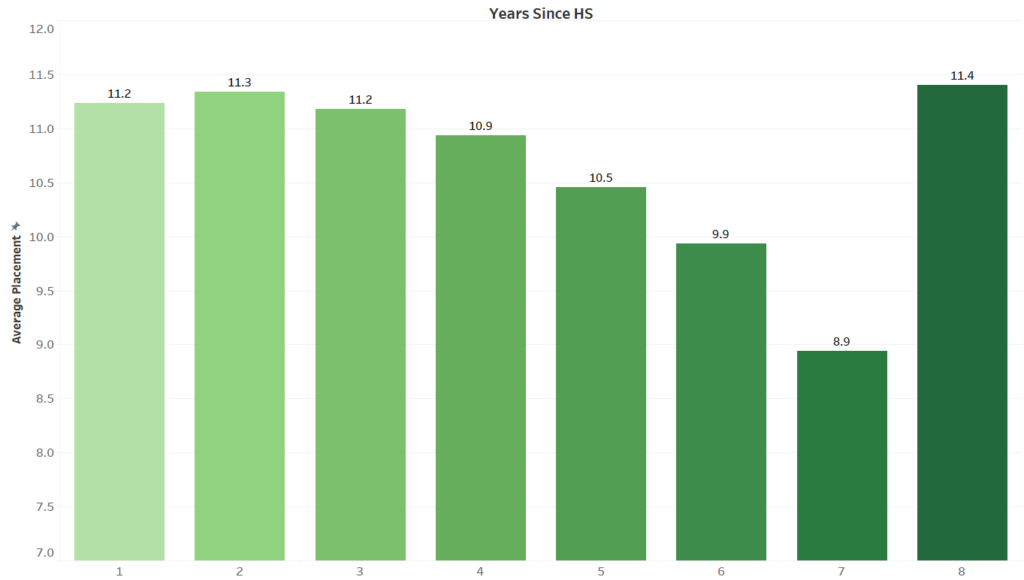
Well, it looks like Neil Young got it wrong.
It seems like it is better to fade away than it is to burn out, after all. Pour one out for the old guys.
Age Related Trivia:
Who holds the record for the longest gap between high school graduation year and participating in the NCAA tournament (13 years) between 1979 and 2025 (that I know of – see above)?


Leave a Reply